

9 things you need to safely tow, park, and level a tiny house
Many factors are involved in safely towing a tiny house on wheels. Most important, of course, is the design of the house itself.
This post will focus on specific safety items and tools you'll need to tow and park a house, and will touch on some important design considerations as well. I've already written extensively, describing in detail my two long towing trips (2,000 miles each) and everything I did to prepare. Please read the two posts below as well to get all the details not included in this post.
- Towing a Tiny House (from California to Texas)
- Our Tiny House Towing Adventure: Part One and Part Two
Towing-conscious design
When designing a tiny house that will be safe to tow, consider the following:
Weight Distribution: Make sure weight is distributed fairly evenly from right to left and front to back, with as much as weight as possible placed over the axels (not at the corners). Don't place all appliances on one side of the house (in a galley kitchen for instance). The axels can more easily handle the weight, so placing heavier items (like appliances -- kitchen, laundry, etc) near the center of house (or 60% back) is a good starting point. A house with an uneven distribution of weight will have more tendency to sway or bounce, both things you definitely want to avoid when towing!
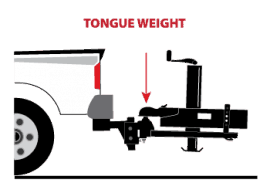
Source: http://www.torklift.com.au/
Tongue Weight: The amount of weight on the tongue (triangle part, where the hitch is) should be from 9-15% of the total trailer weight. So for a 10,000 lbs house, you'd want approx. 1,000 lbs of tongue weight. This is the weight that pushes down on the back of your tow vehicle, insuring that the back wheels of the truck are always in solid contact with the ground and that the connection from trailer to vehicle remains solid (with some downward force). The axels on most trailers are about 60% of the way back from the tongue, which is designed to make sure that there is always adequate tongue weight if the trailer load is balanced correctly (over the axels). Too little tongue weight is very dangerous, because the house will bounce around a lot and will have a tendency to pull the back of the truck off the ground, a very easy way to loose control while towing. Not enough tongue weight also has a huge affect on the amount of sway you'll experience. Too much tongue weight is less of a safety issue, but could easily overload your truck's suspension with more weight than it was designed to carry.
Proper Tow Vehicle: Most tiny houses (especially the large ones being built today) really need a 1-ton truck to tow safely, a 3/4-ton at the very least. This would be something like a Ford F-350 or Dodge/Chevy 3500. In the more extreme cases, you maybe even need a mini semi-truck. Find out the specs of the truck you plan to use and make absolutely certain that it's rated to handle both the overall trailer weight AND the tongue weight. In addition, make sure the suspension on the truck is rated for these weights as well. Some chasis may say they can tow 15,000 lbs, but a 3/4-ton truck may have a lighter weight suspension and cooling system, while it's 1-ton cousin will have beefier suspension, cooling systems and break system to handle the added weight and engine strain.
House Size: It goes without saying that a larger/longer house will be harder to tow. Every foot in length can add considerable weight, and that added length will make for a larger turning radius, making for very awkward situations getting stuck and having to back out of tight spots. Keep within DOT width limits as well (8.5') so you don't need special permits to move your house. The more you plan to move the smaller your house should be. The largest house I've seen successfully used for full-time travel is 20', and that's pushing it! Try to go as small as you can if you think you'll be on the road often. Towing a tiny house is NOT easy, so you'll thank yourself later.
Light Weight Materials: I've seen many stories of people who wanted a tiny house for frequent or full-time travel and we shocked to find out how much they really weighed and how hard they can be to tow. If you plan to travel full-time, 9 times out of 10 an RV or travel trailer (designed to be on the move) will be your best bet. But for those more interested in living than constant travel, you still want to pay close attention to the weight of all the materials you use to build and all items placed within the house. That granite counter top, thick tile, or thick hard wood floor might really weight you down. Consider alternatives made from lighter materials.
OK, enough about design and building. On to some important tiny house towing and parking products.
1. Drive Slowly
Nothing to buy here. Just common sense. Once you are comfortable towing, stay around 60mph even when the speed limit is much higher. Higher speeds (or windy conditions) are where you really start to see problems, so just be slow and smart to avoid them in the first place.
2. Weight Distribution Trailer Hitch
 Even with a well balance house, a weight distribution hitch makes a huge difference in keeping the trailer straight and level as you are moving. These devices help to "distribute" the tongue weight over a wider area of the trailer tongue which has the effect of making the tongue weight more consisant, limiting the up-and-down motion/flex of the trailer hitch coupler. It will help to level the house and truck a bit, keeping the bouncing and flexing to a minimum. These are simple, mechanical products that are relatively inexpensive compared to the cost of the house or truck. Get one!
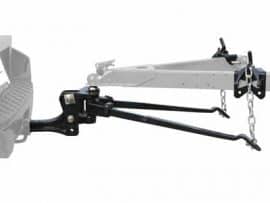
Source: howstuffworks.com
You can also get a weight distribution system that includes and "anti-sway" bar. The anti-sway system performs a similar function as the weight distribution system, only it affect side-to-side movement. Like the name suggests, it will help limit the amount of sway you'll get by adding some friction to the side-to-side movement, slowing down the ability of the house to wiggle as you move. You can still turn the house just fine, but the smaller little sway movements that tend to occur at high speed will be reduced. Swaying is one of the most common issues (and gets worse with speed and wind) so pay attention to this.
3. Spare Trailer Tire
 Nothing is worse than blowing a trailer tire in the middle of nowhere on the side of a busy interstate highway (trust me, I've been there!). Even if you are lucky enough to be near a city, most automotive tire centers to not stock tires for trailers (with a much higher weight-rating). You may end up waiting for days for a special order to arrive. Avoid all the hassle and always travel with a spare trailer tire. Make you get one rated for the weight of your house and the speed you will be traveling.
4. Wheel Chocks
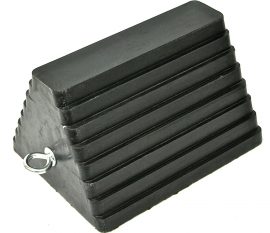 An often overlooked but very important item is the simple wheel chock. This is basically just a heavy duty rubber wedge that you stick under the tires whenever you stop while towing (especially when on a slope). Don't trust your truck's breaks to stop your house from rolling away. When you stop at a rest stop to pee, use the chocks. When you park overnight at an RV park, use the chocks! These are super simple and cheap. Make sure you get at least 2 of them, one for each side of the tire.
5. Walkie Talkies
 As I mention is my more detailed towing post, you'll ideally be moving your house with a friend or partner behind you in a follow vehicle. That way they can watch out for issue on the road, make sure the house is fine as it travels, and can help you flow through traffic much better, anticipating your need to turn or change lanes and helping to clear the space for you. Making countless cell phone calls throughout your journey is hard to do while driving, and frankly, way to slow for a last minute bathroom stop that comes with little notice. To make it easier, just get a simple set of walkie talkies, decent quality ones that can reach at least a few miles in case you lose track of each ether. Talking on walkie talkies is also a lot of fun, and makes the whole towing experience more fun as a result.
6. Jack Stands
 Unless your tiny house trailer has welded-on jacks (the heavy-duty kind, like used on the tongue, meant to support weight over the long-term -- NOT scissor jacks!), you'll want to use a set of jack stands to level the house once you get to your parking spot. Adjustable (so better than cinder blocks), these can support a few tons per stand, so you just need one at each corner (and maybe 2 near the wheels on longer houses). Do not use scissor jacks to support a tiny house -- they are designed for stabilizing an RV only, and will collapse under the full weight of a tiny house if used for long-term support while parked.
7. Bottle (or automotive) Jacks

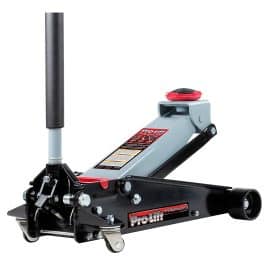 Keep in mind the above items are "jack stands" not "jacks" to they don't do the jacking up themselves. You'll also need a good bottle jack or automotive jack to adjust and level the house in order to get it resting on the jack stands. Your house will likely be very heavy, so make sure the jacks you use are rated for the weight. Bottle jacks move slowly but can support a LOT of weight, so they are a good, relatively inexpensive option. They are also fairly small and compact. Automotive jacks are designed to lift the weight much more quickly, but you'll need a heavy-duty one designed for a large truck, not the smaller, cheaper passenger car jack (check the weight rating -- how many tons?). Auto jacks are much larger as well so finding a place to store them while traveling is not as easy.
8. Large 4' Level
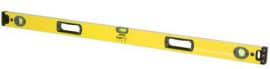 To test your house for level as you're jacking it up and supporting each corner, use a long, 4 foot level along the edge of the trailer. If you spend a significant amount of time in a house or trailer that is un-level, it can be disorienting and you really do notice if it's off by even a little. Some people experience dissiness or balance issues. So spend the time to level it really well before you move in, to avoid any uneasy feelings.
9. Coupler Lock
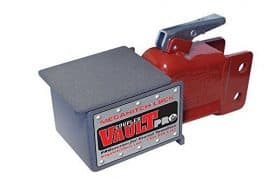 Once you are parked where you're going to live (or even before then, when you are building), use a coupler lock (or wheel lock) to help prevent your house from being hitched up to someone else's truck and stolen. This has happened more than a few times, but a simple lock can go a long way to prevent it. The Megahitch coupler lock is probably your best bet. It seems expensive for something so simple, but as a solid steel box, it's far more effective than the cheaper coupler locks that can easily be cut off with bolt cutters.
Many of the items listed here are essential to a safe and pleasant towing experience, but let me repeat that of even more importance is the design of the house itself, the truck you are using, and the speed and care of the driver.
If you combine good house design and safe towing technique with the above items, you'll be at your final destination, all levelled up and ready to live tiny without too many issues. Avoid the worst case scenario (your dream house toppled on the highway) and spend just a bit of time and money making sure you do it right!

Great article. I've only towed my not so tiny tiny house once and could see that even though I thought I had the weight over the axles, my tiny house still tipped forward, bearing more weight than planned onto the tongue. So weight distribution hitch is definitely a purchase before I move again.
I never hear or read anyone raise the point that the vast majority of tiny house designs result in exactly the worst longitudinal load weight distribution possible, and which will almost always introduce significant dynamic instability when towed at speeds above 45 MPH.
When loading any type of trailer, especially those attached to the tow vehicle via a standard ball hitch mount (as opposed to 5th wheels), ensuring the the load distribution placed upon that trailer is as close to ideal as possible. The goal is to place at least 60% of the total load weight directly over the axle, or at the center point of multiple axles (or exactly centered over the center of gravity (CG) if you can determine where it is), then 20% of the load spread out as much as possible both forward and reward of the CG, getting as close to a balanced mirror image load gradient of sorts as possible.
I've heard people say that more weight being placed ahead of the CG and onto the ball hitch mount assembly is ideal, but the laws of physics categorically disagrees. The further away from the 60/20/20 balanced load spread a trailer is, the less dynamically stable the trailer becomes, which is then further exacerbates exponentially as towing speeds increase. While how this instability manifests at any given moment differs between front heavy and rear heavy load weight distribution, the potential list of day ruining end results is largely the same.
Most tiny house design doctrines prioritize efficient use design well above all other considerations, towing stability almost always being close to the bottom of the list. As the confines of the small area inherent to tiny houses usually dictate, most designs place the kitchens and bathrooms at the extreme front or back of the trailer. The area above the axles is almost always left as an open space for the owners to furnish. One couldn't deliberately design a trailer with more dynamic instability when towing if they wanted to.
I towed my 24' long, 13' high tiny house from upstate New York up to northeastern Maine, which represented the heaviest, highest, and unstable trailers I've ever towed with a truck. We used a rented 1 ton Ford F-350 pickup truck which by sheer luck was a dually with a massive twin turbo diesel engine. Even with the added lateral stabilizing effect of the dually feature, I spent 12 white knuckle hours driving no faster than 50 MPH, and had to manually engage the trailer brakes via the integrated controller at least a dozen times when the trailer would destabilize and enter into a state of increasing harmonic sway oscillations, which of not immediately addressed in that way would have been likely increased quickly eventually rolling the truck and house.
If you can redistribute the weight inside the house to get any closer to that 60/20/20 distribution before towing, do yourself a favor and put in the effort. I'm any case, don't ever get too comfortable and no matter how exhausting it can be, remain spring loaded to grab that manual brake slider level the entire trip. Don't go crazy and slam the trailer brakes on full blast, it usually only took a ¼ of the travel to settle it down.
Great article though, thanks for the knowledge!!!